Architecture
Method
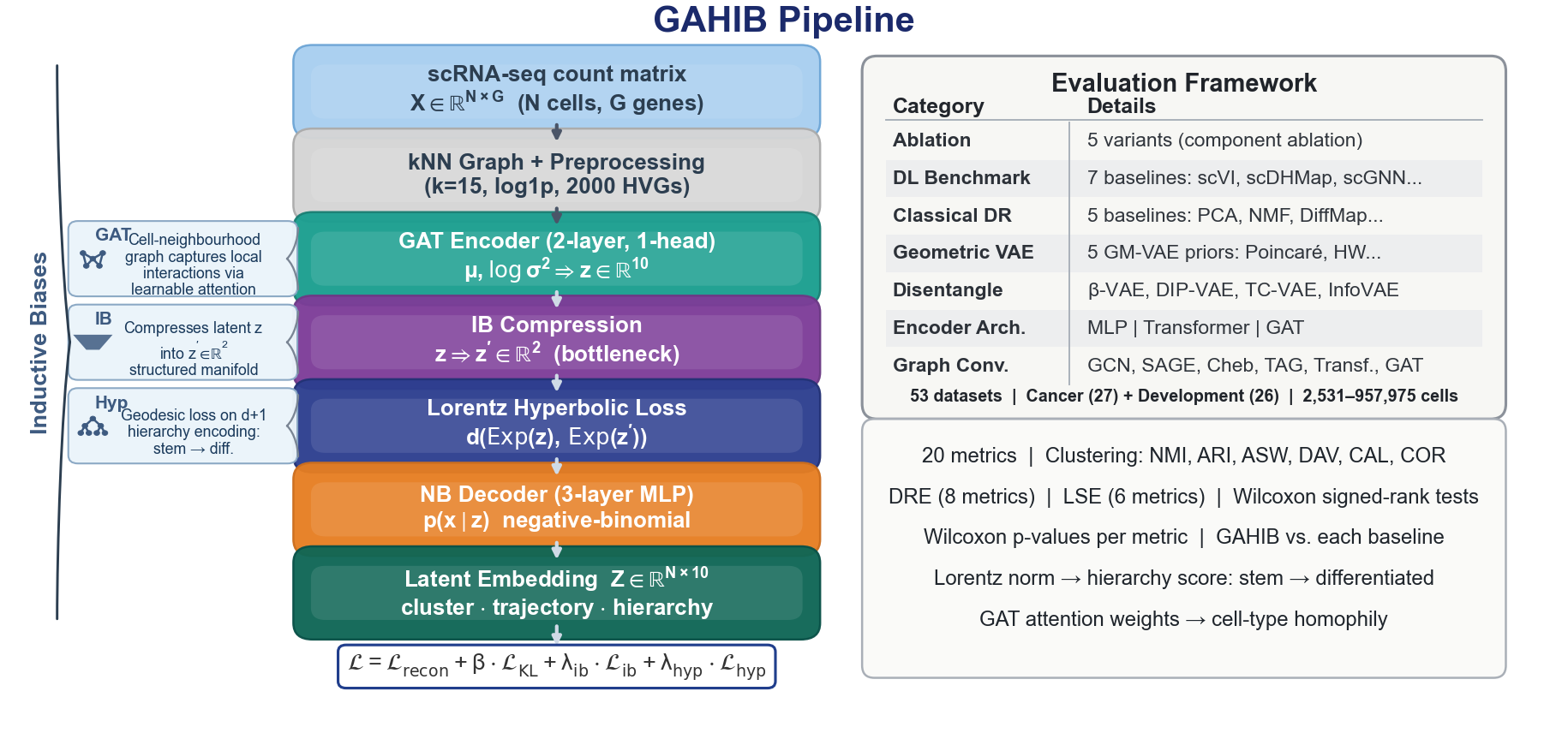
Encoder options: MLP, Transformer, GAT, GCN, GraphSAGE, ChebConv, TAG, GraphTransformer, ARMA.
Detailed benchmark figures remain gated; architecture and objective details are safe preview content.
Mechanism summary
Graph-attention VAE with bottleneck geometry
Encoder
Graph-aware counts
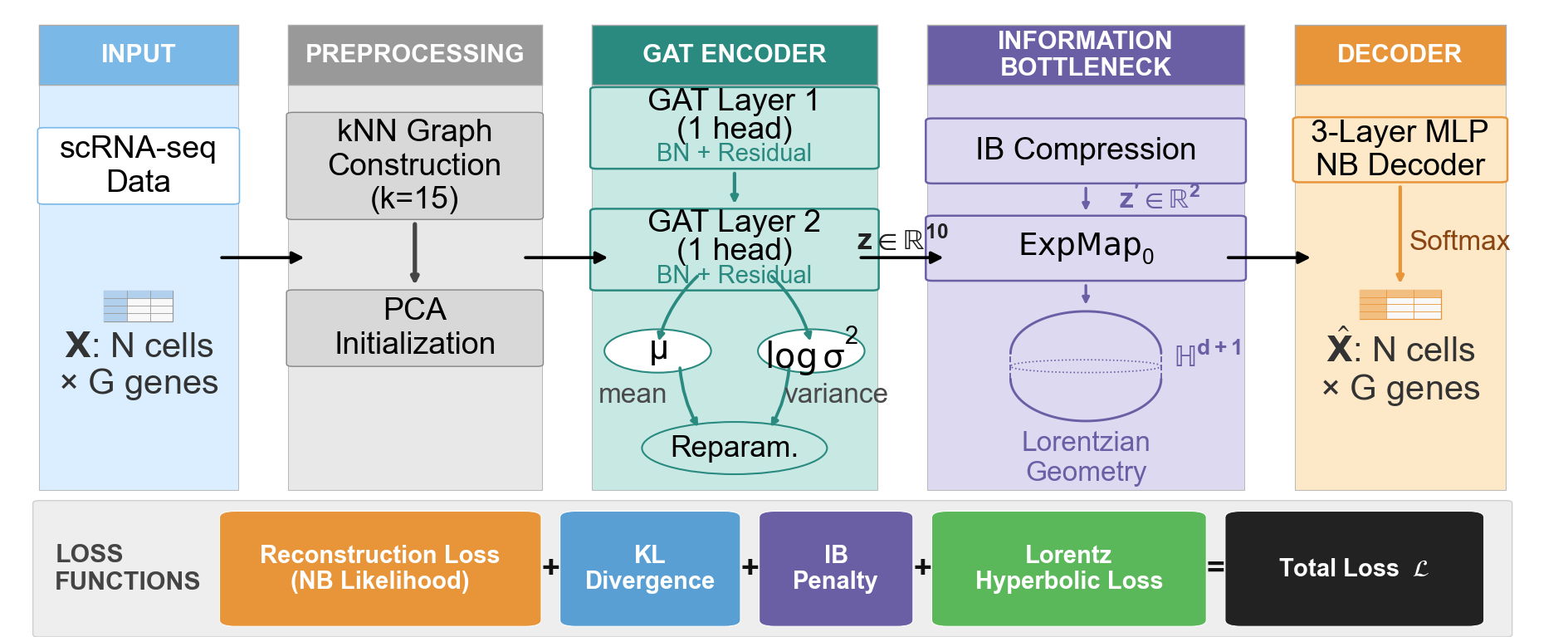
A graph or sequence encoder maps single-cell counts into a shared latent representation.
Bottleneck
Compressed manifold
A low-dimensional coordinate is trained directly instead of relying only on post-hoc projection.
Geometry
Lorentz hierarchy
The hyperbolic objective encourages radial hierarchy and angular lineage separation.
Objective
Three coupled losses
Reconstruction. A count likelihood - negative-binomial, zero-inflated negative-binomial, Poisson, or zero-inflated Poisson - fits the raw counts.
Information bottleneck. A second decoder reconstructs the input from a 2-D manifold coordinate, compressing the latent into a low-dimensional representation suitable for visualization and trajectory analysis.
Lorentz hyperbolic loss. Anchors the manifold coordinate on the hyperboloid model of hyperbolic space. Radial distance from the origin encodes hierarchy: cells closer to the origin sit higher in the developmental tree, and lineage divergence maps to angular separation.
Lorentz distance
The Lorentz distance between two points on the hyperboloid is
where the Minkowski inner product is
Reference diagrams
Manuscript figures
Important constraint
The hyperbolic loss is degenerate when the bottleneck coordinate is untrained. The implementation enforces this dependency when the bottleneck reconstruction weight is zero.
Optional trajectory modules
Stochastic differential equation and partial differential equation modules are provided for trajectory experiments. These are off by default and documented in the source.
Detailed quantitative comparisons against baselines, ablations, and interpretability analyses appear in the manuscript and will be published on this site upon journal acceptance.
Continue